by Brad Strong | Jun 6, 2017 | Blog, CAD Comparison, CAD Performance, CAD Systems, CAD Translation, What's New |
We’re reviewing an article written by Stephen Wolfe on How to Choose a CAD System. Since a lot has changed since the article was first published, we’re noting what’s still of value as well as bringing in new information. For the original article and Stephen’s list, click here. Here’s Stephen’s original list: Capable, efficient 3D design Compatibility with customers and suppliers Drafting tools that meet your standards Reliability and stability Built in applications that help your business Pleasant business relationships Short learning curve Innovative R&D to protect your investment A dealer who can help you Drafting...

by Brad Strong | Nov 16, 2016 | Blog, CAD Comparison, CAD Translation, CAD Validation, What's New |
The Boeing Task Guide – Solutions This is our fourth article on the subject of Aerospace Validation. For previous articles, see this introductory article on Boeing Validation Spec D6 (which focuses primarily on data extraction), part 2 of the same article (which focuses on validation of derived CAD models), as well as this article on the AS9100 standard (which is more commonly used in Europe). This article addresses elements of the Boeing DPT Task Guide, also known as the Assessor Task Guide Section 19: Does the supplier verify dataset translations when a supplier translates Boeing authority datasets from their as received format into their manufacturing...

by Brad Strong | Oct 20, 2016 | Blog, CAD Comparison, CAD Validation, What's New |
Boeing Spec D6-51991 Part 2 addresses another critical aspect of the Boeing D651991 spec: Translations. For our recent articles on aerospace validation checking, see this introductory article on Boeing Spec D6, as well as this article on AS9100. Boeing requires suppliers to validate that models used for downstream operations by the supplier are, within a specific tolerance, the same as the files originally provided by Boeing. This is called Model Validation. See a short model validation capabilities overview video (article continues below): 8.2 – Translations When suppliers translate from Native CAD format to alternate formats including...

by Brad Strong | Oct 10, 2016 | Blog, CAD Comparison, CAD Translation, CAD Validation, What's New
Last week we overviewed the advantages TransMagic can give aerospace manufacturers who need to comply with the AS9100 standard. This week we dig into Boeing spec D6-51991. Part 2 of this article covers Boeing D6 Spec Translations; if you need information on Aerospace Standard 9100, see the AS9100 article here. Boeing maintains strict standards for CAD geometry used for their design and manufacturing processes; if you are a supplier to Boeing, or a sub-tier supplier to Boeing, you may be subject to requirements of Boeing Spec D6-51991, which consolidates and replaces several previous requirements. This post will focus on section 7.5 of the spec,...

by Brad Strong | Sep 28, 2016 | Blog, CAD Comparison, CAD Performance, CAD Translation, What's New
Aerospace Standard AS9100 is a standard for quality management systems (QMS) for the aerospace sector. This standard is based on ISO 9001, but with additional aerospace-specific requirements added; it is a global standard, and is published by different countries separately. The AS9100 standard was first released in October 1999 by the Society of Automotive Engineers and the European Association of Aerospace Industries, but it continues to evolve; AS9100-C was released in 2009, and AS9100-D was released in September of this year (2016). AS9100 is Concerned with Processes How do the all the processes in the company interact and integrate? Organizations keeping...
by Brad Strong | Sep 19, 2016 | Blog, CAD Comparison, What's New
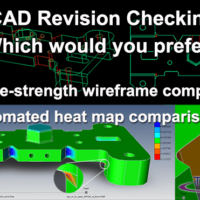
When checking customer revisions, if you miss a change, there is the potential to order wrong parts and even manufacture wrong parts. I sometimes ask TransMagic users how often their customers make changes that are undocumented; one said “oh, about 85% of the time”; another said “7 out of 10 times”. Apparently it is not that unusual for the customer to fail to communicate all the changes made at each revision. If estimators of the manufacturing world miss a single customer change they run the risk of: Misquoting the part, thereby potentially charging too little for the tooling they create Creating the wrong tooling, thereby wasting time...